/ writing
Caveat Emptor
In 2016, I wrote an article debunking the idea of a tech bubble, as claimed by Bill Gurley, Janet Yellen, Mark Suster, and others. Despite a -10% drop in the Nasdaq index, I argued that the technology economy was stronger than ever. However, now I believe we are witnessing a significant shift that could lead to a substantial pullback, that few are prepared for.
Working in the sector has provided me with a unique perspective that those in their ivory towers might miss. Let me explain the nuances of the tech ecosystem, which has largely been immune from the traditional business cycle until now.
A self-sustaining organism, the tech sector has thrived due to its internal spending dynamics. According to Crunchbase projections, over $1.5 trillion was invested in venture capital deals, worldwide between 2010 and 2019. Topping off at an eye popping $671 billion of investments into firms for the full year ending in 2021. Forecast have growth CAGR of around 16% during through 2026. To give you context on the lunacy for that figure to hold it would calculate to the following:
- 2023: $778 billion
- 2024: $902 billion
- 2025: $1.04 trillion
- 2026: $1.20 trillion
Apple has benefited from venture-backed startups predominantly using Macs since 2009. However, with recent layoffs and a slowdown in growth, the tailwinds that have driven Apple's revenue for the last decade are disappearing.
This trend extends beyond Apple to other B2B services, such as AWS, Azure, and GCP, all of which have profited from the incestuous nature of venture capital spending. In 2021, US venture funding amounted to $344.7 billion, with nearly $137 billion finding its way back into the coffers of Google, Facebook, and Amazon. This figure does not even include spending on Apple, Microsoft, Salesforce, Adobe, Workday, Atlassian, Zoom, or other non-tech companies like Trinet.
The outlook isn’t good.
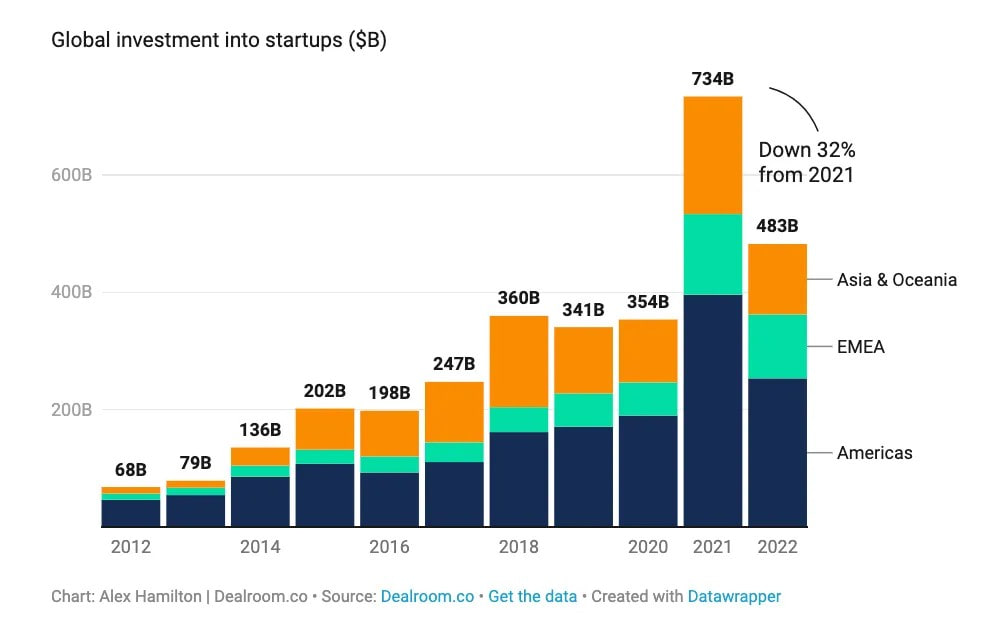
The uniform tech stack found at the majority of tech companies reveals an alarming interdependency. The r squared of their revenues to venture funding, on both an absolute level and a rate of change basis is over 92. The non-linear second and third order effects of the high-paying tech layoffs are truly impossible to fully contextualize. But it's very easy to foresee that it will no longer guarantee purchases of Tesla vehicles or the latest iPhone. In my 2016 article I definitively stated, "I can tell you from my work, my co-workers work, that we haven’t missed a beat. We are all humming along just fine." However, the current reality is starkly different: "There are no more beats. The music hasn't slowed. It's stopped."
Predicting short-term market trends is challenging, but medium-term forecasting becomes increasingly accurate. The unfolding events in the tech sector point to the largest pullback since 2000, eclipsing even the 2008 global financial crisis due to its sheer size and interconnected nature. This is not idiosyncratic regional banks, crypto currencies, or commercial real estate, its everything. It’s leverage.